Coin, token and market cap
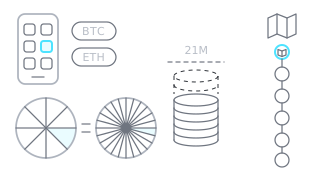
A coin has its own network (BTC, ETH), while a token runs on another network. Market cap is the price multiplied by the number of units in circulation.
Coin and token
A coin has its own blockchain: BTC runs on the Bitcoin network and ETH on the Ethereum network. A token has no network of its own and is built inside another one; many tokens run on Ethereum, for example. In everyday talk the words get mixed up, but the difference matters when you move funds: when sending a token you have to pick the right network. The stablecoins USDT and USDC, for example, are tokens that run on several networks.
How market cap is calculated
Market cap is the price multiplied by the number of units in circulation. It shows how much the market values the whole project right now, not one coin.
Example: coin A costs 0.01 USD and there are 100 billion units in circulation, so its market cap is 1 billion USD. Coin B costs 50 USD but has only 10 million units in circulation, so its market cap is 500 million USD. The "cheaper" coin A is twice as big a project.
Market cap and FDV
FDV (fully diluted valuation) is calculated from the maximum supply instead of the circulating one. If only 20% of all coins are in circulation, FDV is five times the market cap. The remaining coins may be released later and push the price down. BTC has a capped supply: there will never be more than 21 million units (bitcoin.org).
Common mistakes
- Judging a coin by its unit price. A "one-cent coin" is not cheap if hundreds of billions of them exist.
- Working out what a coin would cost at another coin's market cap. That sum says nothing about the chances of it happening.
- Ignoring future supply. A big gap between market cap and FDV means many new coins may reach the market later.
- Sending a token on the wrong network. The same token can exist on several networks, and that mistake can cost the full amount sent.
How to practise
Pick three coins and, on public data aggregators, write down their price, circulating supply and max supply. Work out market cap and FDV yourself, then compare with the published figures. That builds the habit of looking at project size rather than unit price. If you are just starting, read How to start trading crypto.
Frequently asked questions
Does a large market cap mean lower risk?
What is the difference between circulating and max supply?
Is a token worse than a coin?
You can review and test yourself on these terms in the Skenuok app.