How to start trading crypto: a plan for your first 30 days
If you are wondering how to start trading crypto, your first month should teach you, not earn you money. This plan takes you through four weeks: security and checking the platform, practice without money, small spot trades and a journal review. The charts are built from real Binance data, and the legal and tax facts come from official sources.
Crypto trading for beginners: what to expect in your first 30 days
Trading crypto is a skill, a bit like driving. In your first month you are not learning to race, you are learning not to crash. That is why the goal of this plan is not profit but three things: a secure account, clear rules and the habit of writing down every decision.
In a warning published in October 2025, the European supervisory authorities (EBA, EIOPA and ESMA) remind consumers that the prices of most crypto-assets swing sharply, so you can lose a large part or even all of the money you put in. The compensation schemes that cover traditional financial products do not apply to crypto-assets. The chart below shows what happened to even the largest cryptocurrency over almost nine months.

If 1,000 USDT had been put into BTC right at the peak, about 458 USDT would have been left at the lowest point. That is why the money you start with should be money whose loss would not change your daily life: not a loan, not a home deposit and not your emergency savings.
The plan at a glance
| Week | Goal | What you do | When to move on |
|---|---|---|---|
| 1 | Security and platform | 2FA, seed phrase, MiCA licence check, a small test withdrawal | Every security step is done |
| 2 | Chart basics without money | Candles, levels, 10 paper trades with a plan | Every paper trade has a stop and a target |
| 3 | Small spot trades | The 1% risk rule, limit orders, a stop set in advance | Not a single trade without a stop |
| 4 | Journal and review | You read every entry and find 1-2 recurring mistakes | You know what you will do differently next month |
Week one: security before your first euro
It is worth sorting out security before you even open a chart. A bad trade costs part of the amount, while a stolen account or seed phrase can cost everything.
Two-factor authentication (2FA)
- Turn on 2FA for your email and for your platform account. Start with email, because that is where your other passwords get reset.
- Choose an authenticator app or a physical security key. An SMS code is better than nothing, but scammers can intercept it by tricking the operator into moving your phone number to their own SIM card, which is known as SIM swapping.
- Write your backup 2FA codes on paper and keep them away from your phone.
- Use a separate long password for every account. A password manager makes this much easier.
- Do not log in to your crypto accounts over public or unsecured Wi-Fi. The EU supervisors' warning recommends this too.
Seed phrase (recovery phrase)
If you keep crypto in your own wallet rather than on a platform, you usually get a seed phrase of 12 or 24 words. It is the whole key to your funds: whoever has the phrase controls the coins. The EU supervisors stress that if you lose your private keys, you lose access to your assets for good. When coins are held on a platform, the company controls the keys, and your account is protected by 2FA and your password. We explain the types of wallets in the glossary.
- Write the phrase down by hand on paper. Do not photograph it, store it in the cloud or email it to yourself.
- Never type it into a website, a form or a chat. Real support staff never ask for it.
- Keep it where neither a thief nor water can reach it. Some people stamp the phrase onto a metal plate.
How to recognise scammers
The Bank of Lithuania lists the most common signs of investment fraud (page in Lithuanian). For a beginner, these matter most:
- Quick, unrealistic profits are promised with almost no risk.
- Ads use the faces of famous people and invented stories of their success.
- A consultant keeps calling and messaging you and pushes you to invest more.
- Someone offers, for a fee, to “recover” money you lost before.
Add one more rule to this list: never give anyone remote access to your computer or phone, and never share your 2FA codes. The Bank of Lithuania also publishes a list of blocked websites that offer illegal financial services.
How to check a crypto exchange: the MiCA licence
Since 30 December 2024, the MiCA regulation (Markets in Crypto-Assets Regulation) has applied in full across the EU. In Lithuania, the transitional period ended on 1 June 2025: the Bank of Lithuania stated that after this date crypto-asset services can only be provided with a MiCA licence. Across the EU, the transitional period ended on 1 July 2026. An ESMA statement says that after this date a firm serving EU clients without a MiCA licence is in breach of EU law.
In this plan we are talking about a centralised crypto exchange (CEX) run by a company. We deliberately do not name any platforms. Instead, here is a check you can do yourself:
- Find the name and country of the legal entity in the platform's terms of use. A brand and a company are not the same thing.
- Check whether this legal entity appears in the ESMA MiCA register among authorised crypto-asset service providers (CASPs).
- See which services the authorisation covers. The EU supervisors point out that a firm may be authorised for only part of what it does.
- Check that the website is not on the Bank of Lithuania list of blocked websites.
- If you decide to use the platform, you can start by depositing a small amount and testing a withdrawal back to your bank account. Only then decide whether to keep using it.
Also notice what the platform pushes first. If right after you sign up it invites you to use leverage, promises deposit bonuses or offers to copy other people's trades automatically, that is a sign to slow down.
Spot vs futures: why to start without leverage
In spot trading you buy the coin itself. If the price falls 10%, the value of your position falls 10%, but the position stays yours and can wait. Futures let you trade with leverage: you control a bigger position than the collateral you put in. With 10x leverage, a move of about 10% against you equals all the collateral behind the position, so the platform closes the position by force even earlier. This is called liquidation.

Within these four hours, price fell 12.6% from the open to the low, then recovered to 112,774.50 USDT by the end of the candle. Let us compare two cases where a position was opened at the start of that candle:
- Spot without leverage. At the end of the candle the position was down 3.3%. Unpleasant, but the position survived.
- A long position with 10x leverage. A 12.6% drop is more than 10%, so the position would have been liquidated before price even reached the bottom, and the collateral would have been lost. The exact liquidation level depends on the maintenance margin and the mark price, but Binance futures data show that the mark price also fell about 12.6% during that candle.
One more lesson from the same candle: if the spot position had a stop loss order 5% below the entry, it would have been triggered. In a fast drop, a stop-market order can be filled at a worse price than the one you set because of slippage, and a stop-limit order may not be filled at all.
Leverage does not make you a better trader: it magnifies the profit and the cost of a mistake alike. We explain how margin, the funding rate and liquidation work in the article Leverage and futures. In this plan, the whole first month is without leverage.
Week two: chart basics and practice without money
In week two you learn to read a chart and test what you learn without money. Five topics are enough to begin with, and we have a separate article for each:
- Technical analysis for crypto: how to read a chart and what it cannot tell you.
- Candlestick patterns: what the body and wicks of a candle show and which candlestick patterns are the most common.
- Support and resistance levels: where price often stops or turns.
- Chart patterns: triangles, flags, head and shoulders.
- Risk management and stop loss: how much to risk and where to place the stop.
How to do a paper trade
Paper trading means you plan a trade and follow it, but no money is involved. To make it useful, you write the plan down before the result, not after it.
- Pick a pair and a timeframe, for example BTC/USDT 4h.
- Mark the level where you plan to make a decision and write one sentence on why it matters.
- Write down the entry price, the stop, the target and the risk to reward ratio.
- Decide when the idea is no longer valid, for example if a 4h candle closes below the level.
- After 1-3 days, record the result: target hit, stop hit or neither.
After ten such entries you will start to see where your plans most often go wrong: a stop placed too close, a target set too far or an entry without confirmation.
A daily routine in the app
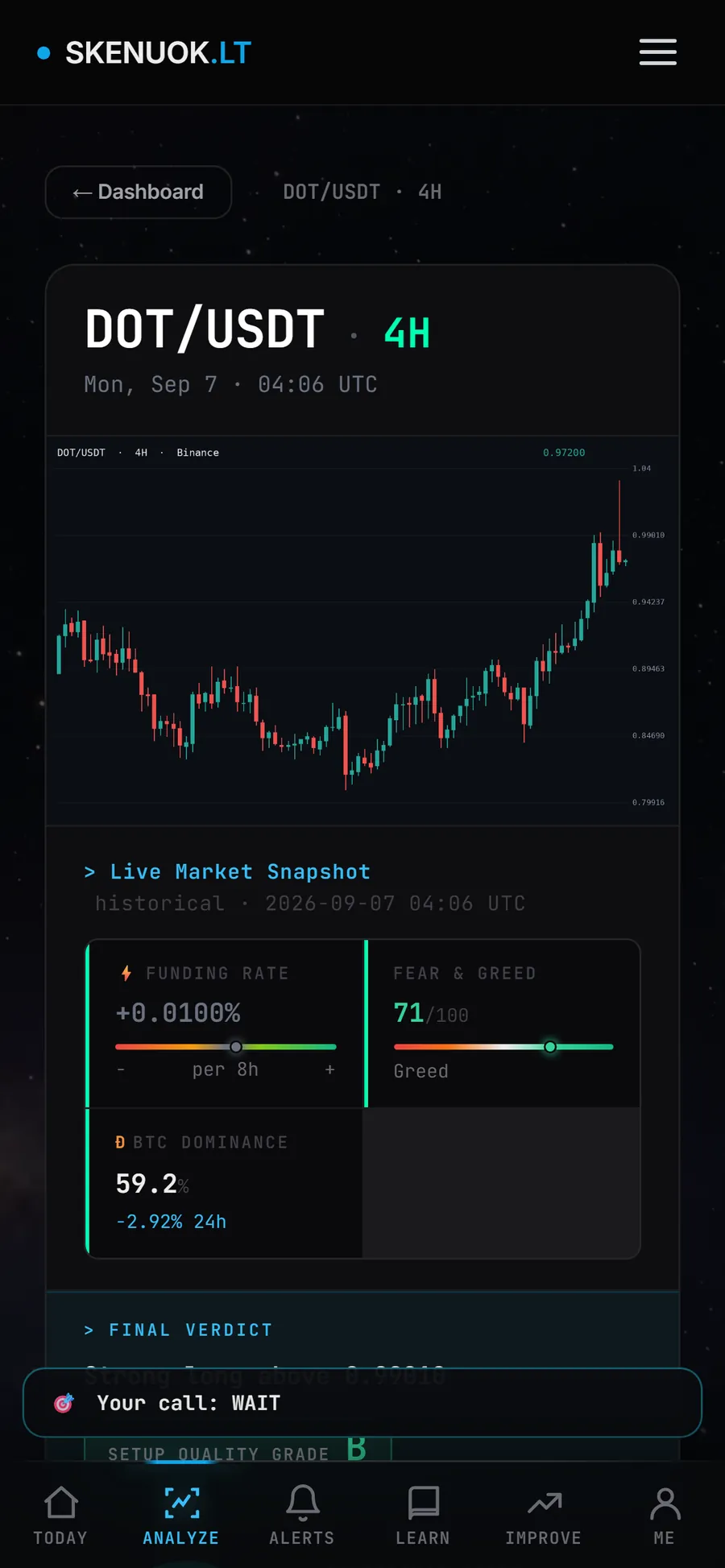
In the Skenuok app, the same practice becomes a daily routine. For the daily scan, the app picks one setup out of the top-50 coins, and you call the direction before you see the verdict. For learning, there is an academy with six modules, from the basics to trade execution.
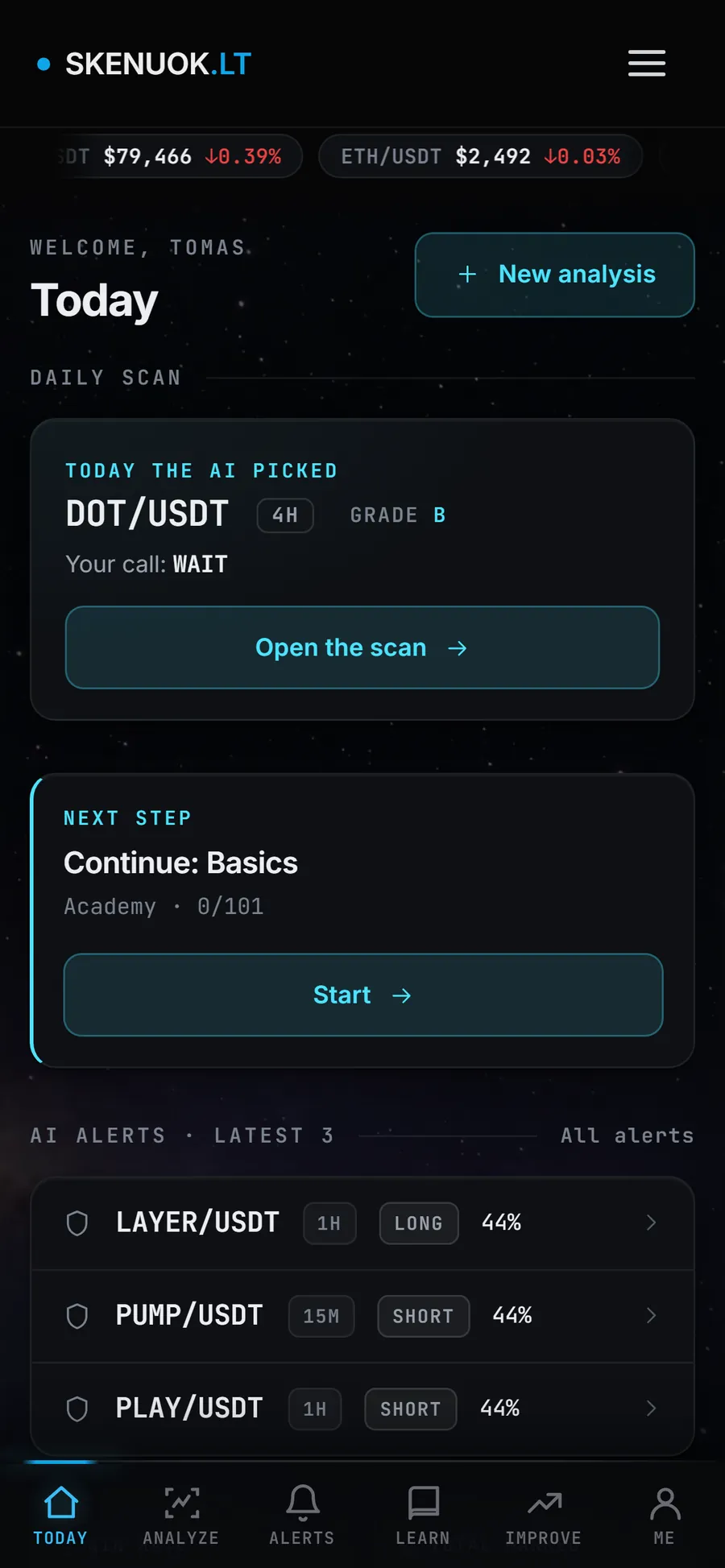
The routine takes about ten minutes a day. In the morning you read the daily market context and make your call before the verdict. In the evening you go through a few review cards, picked along the forgetting curve. A personal 30-day plan gives you one task per day based on your weak topics, and the “Guess before the AI” and “Decision modes” drills let you practise without any risk.
Week three: small spot trades and position size
If after two weeks of paper trades you decide to move to real money, the most important number is not the target but the risk per trade. A simple starting rule: no more than 1% of the account at risk on any single trade.
Position size is calculated like this: position = risk in euros / distance to the stop. The distance to the stop is written as a fraction of the entry price: 2% = 0.02, so €5 / 0.02 = €250.
| Account | Risk (1%) | Distance to stop | Position size |
|---|---|---|---|
| €500 | €5 | 2% | €250 |
| €500 | €5 | 5% | €100 |
| €1,000 | €10 | 4% | €250 |
| €1,000 | €10 | 8% | €125 |
The further away the stop, the smaller the position, but the risk in euros stays the same. Trading fees and possible slippage come on top, so the real loss is usually a little bigger. You will find more examples in the article Risk management and stop loss.
Three rules for your first trades
- The stop loss order is set right away, together with the entry, not when price is already falling.
- With a limit order you set the price yourself, while a market order is filled immediately at the best price available at that moment. On pairs with low liquidity, a market order can be filled at a worse price than you expect.
- No more than one or two positions are open at the same time, so you have time to record each one in your journal.
Week four: the trading journal and review
A journal turns experience into data. Without one, after a month you will remember a few vivid trades, but not what you kept doing again and again. For every trade, real or paper, six fields are enough:
- Date, pair, timeframe and direction.
- The reason in one sentence: which level or pattern you saw.
- Entry, stop, target and position size.
- The result in euros and in percent.
- Did you stick to the plan: yes or no.
- How you felt before the trade: calm, in a hurry, wanting to win it back.
On the last day of the month, read all your entries and answer three questions:
- In how many of your trades did you stick to the plan?
- Which mistake came up most often?
- What will you do differently next month?
A good first month is shown not by profit but by the fact that almost every trade had a plan and a stop. Over 30 days, profit or loss can be down to chance, while discipline shows whether you really follow your own process.
Crypto taxes in Lithuania: what to know in advance
Taxes can come as a surprise, because swapping crypto for euros is not the only thing that counts. The seminar material of the State Tax Inspectorate (VMI) from 2026-09-30 (in Lithuanian) states that a Lithuanian resident is treated as having received income, among other cases, when they exchange crypto for euros or another official currency, when they exchange one cryptocurrency for another and when they pay for goods or services with crypto.
The same material says that if you are not registered for individual activity (self-employment) and the annual difference between your income from selling crypto and other assets that do not need to be registered and your documented acquisition costs does not exceed €2,500, it is not subject to personal income tax (GPM) and does not have to be declared. Sales of personal belongings, for example, also count towards this difference. If the difference is larger, the VMI example taxes only the part above €2,500. For income received in 2026 and later, the rate is 15%, and higher annual income (in 2026, above €27,745.80, counted together with other income not related to employment) is taxed at 20%, 25% or 32%. The annual GPM311 return is filed by 1 May of the following year.
In practice this means one thing: keep proof of your purchases from your very first trade. It is worth downloading the platform's trade report every month, so your history is not lost if you ever have to close the account.
Frequently asked questions
How much money do I need to start trading crypto?
Is crypto trading legal in Lithuania?
Do I pay tax in Lithuania if I swap one cryptocurrency for another?
Where to start: spot or futures?
Can you learn to trade crypto in a month?
You can turn this practice into a daily routine: in the Skenuok app you read the charts yourself, and the app checks your read.