Stablecoin
A coin whose price is pegged to the dollar or another stable asset, e.g. USDT or USDC. It is meant for holding value, not for profiting from price moves.
What it is
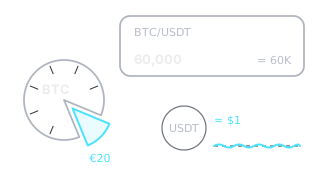
A stablecoin's price is pegged to another asset, most often the US dollar: 1 USDT or 1 USDC should be worth about 1 USD. That is why stablecoins act as cash on crypto exchanges. The BTC/USDT pair shows how many USDT, roughly dollars, one BTC costs.
How the peg is held
In the most common model the issuer holds a reserve for every coin it issues, such as bank deposits and short-term US Treasury bills, and lets holders redeem coins for dollars. There are also algorithmic stablecoins that try to hold the price without a full reserve. The risk of that model became clear in May 2022, when UST lost its dollar peg and its price fell close to zero (US SEC).
In the European Union, MiCA rules for stablecoins have applied since June 2024 (Bank of Lithuania). Coins pegged to a single official currency, such as USDC, count as e-money tokens, and only a licensed credit or e-money institution may offer them to the public in the EU (MiCA, Article 48).
Real example: USDC in March 2023

In March 2023 US regulators closed Silicon Valley Bank. USDC issuer Circle said it held 3.3 billion USD there, about 8% of the USDC reserve (Circle statement). On Binance, where USDC/USDT data starts on 11 March at 14:00 UTC, price dipped to 0.882 in the first minute and hovered around 0.91 for hours. On the evening of 12 March, after US authorities stepped in, Circle said the whole deposit would be available, and by the evening of 13 March price was back near 0.995. The lesson is simple: "stable" means pegged, not risk-free.
Common mistakes
- Treating a stablecoin like money in a bank account. It is the issuer's promise, and that promise is only as good as its reserves.
- Keeping everything in one coin on one platform. The risk sits both in the coin and in the exchange or wallet.
- Mixing up networks. The same USDT exists on several blockchain networks. Send it on the wrong one and you may not get the funds back.
- Assuming USDT always equals 1 USD. Under market stress the exchange price can drift for a while.
How to practise
Charts quoted in USDT are, roughly, in dollars. Watch stablecoin supply: its growth is often read as new money coming into the crypto market. In the Skenuok app, the daily market context shows stablecoin supply next to ETF flows. New to crypto? Read How to start trading crypto.
Frequently asked questions
What is the difference between USDT and USDC?
Can a stablecoin fall below 1 USD?
Are there euro stablecoins?
You can review and test yourself on these terms in the Skenuok app.