Crypto leverage trading and futures: how liquidation works
Leverage lets you open a bigger position than the money you have. It also brings liquidation closer: the moment the exchange closes your position by force because the loss has eaten through your margin. Below we show in numbers how far the price has to move before liquidation at 2x, 5x, 10x and 20x leverage, and what happened on May 19, 2021, when the BTC price briefly fell about 30% within 13 hours.
In short: five things about leverage
- Leverage does not make you more likely to be right. It makes the position bigger, and it multiplies both profit and loss by the same factor.
- For a rough distance to liquidation, divide 100% by the leverage. A 10x position needs only about a 10% move against you, a 20x position about 5%. In practice, liquidation comes even earlier.
- A stop loss order, or simply a stop, placed beyond the liquidation price will not trigger. The exchange closes the position first.
- In cross margin mode you can lose the entire balance of your futures account, not just the amount set aside for one position.
- Regulators record heavy losses. According to national regulator data published by ESMA in 2018, 74-89% of retail client accounts typically lose money when trading CFDs (contracts for difference) with leverage.
Futures trading: what it is and how it differs from spot
On the spot market you buy the coin itself. If BTC falls 30%, your BTC is worth 30% less, but nobody sells it for you by force. The most you can lose is what you paid.
A futures contract is an agreement on price: its value tracks the price of the coin, but you do not own the coin itself. Crypto exchanges commonly offer perpetual futures: they have no expiry date, and their price is kept close to the spot price by the funding rate, which we explain below. With a futures contract you can open a long position, which gains when the price rises, or a short position, which gains when the price falls. Both directions are explained in more detail in the glossary.
| Spot | Perpetual futures | |
|---|---|---|
| What you hold | The coin itself | A contract on price, not the coin |
| Can you profit when the price falls | No | Yes, with a short position |
| Leverage | None | You choose it, and exchanges allow very high leverage |
| Liquidation | None | Yes: the exchange closes the position when the loss eats through the margin |
| Holding cost | None, only the trading fee | Funding payments every few hours: sometimes you pay, sometimes you receive |
| Maximum loss | What you paid | The full margin of the position, and in cross mode your whole balance |
For a beginner, the most important difference is time. On the spot market a price drop reduces the value, but the position stays open. With leverage, a single sharp candle can close the position before the price has a chance to recover, if it recovers at all. If you are just starting out, first read how to start trading crypto.
What leverage and margin are
Margin is your money that the exchange locks up as collateral. Leverage shows how many times bigger the position is than the margin. With 100 USDT of margin and 10x leverage, you open a 1,000 USDT position.
Profit and loss are calculated on the whole position, not on the margin. Say the position is long. When the price rises 5%, the 1,000 USDT position makes 50 USDT, which is 50% of the margin. When the price falls 5%, you lose the same 50 USDT. When it falls about 10%, the margin is gone.
Exchanges use two margin levels. Initial margin is what you need to open a position. Maintenance margin is the minimum that must remain for the position to stay open. When losses push the remaining margin down to that level, liquidation begins: the exchange closes the position itself, and the margin set aside for that position is usually gone.
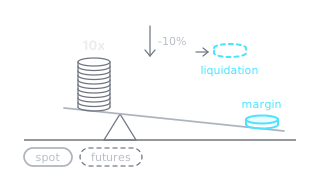
How far the price must move before liquidation: 2x, 5x, 10x and 20x
A simplified rule for isolated margin mode: divide 100% by the leverage and you get the approximate distance to liquidation. For a long position, the liquidation price sits roughly that many percent below the entry. For a short, it sits the same distance above. The table shows an example with a 1,000 USDT position and an entry price of 60,000 USDT.
| Leverage | Margin for a 1,000 USDT position | A 1% move against you costs | Distance to liquidation (simplified) | Long liquidation from 60,000 | Short liquidation from 60,000 |
|---|---|---|---|---|---|
| Spot, no leverage | 1,000 USDT (you buy the coin) | 1% of the value | No liquidation | None | Not applicable |
| 2x | 500 USDT | 2% of the margin | about 50% | about 30,000 | about 90,000 |
| 5x | 200 USDT | 5% of the margin | about 20% | about 48,000 | about 72,000 |
| 10x | 100 USDT | 10% of the margin | about 10% | about 54,000 | about 66,000 |
| 20x | 50 USDT | 20% of the margin | about 5% | about 57,000 | about 63,000 |
| 50x | 20 USDT | 50% of the margin | about 2% | about 58,800 | about 61,200 |
The point is simple: the higher the leverage, the smaller the move that knocks you out. In crypto, a 5% move in a day is not unusual. We counted it from Binance BTC/USDT daily candles: from 2025-10-01 to 2026-09-30 there were 16 days when the price fell at least 5% below the daily open at some point during the day, and 17 days when it rose at least as much above it. A 20x long opened at the start of such a down day (00:00 UTC) would, in simplified terms, have been liquidated, even if the price came back later. For a 20x short, the 17 up days were just as dangerous.
Why liquidation comes earlier in practice
- Maintenance margin. The exchange closes the position not when the margin hits zero, but when only the maintenance level is left. If that level is, say, 0.5%, a 20x long from 60,000 is liquidated at about 57,300, not 57,000.
- Fees and funding. Trading fees and funding payments reduce your balance, and on some exchanges the margin of the position itself.
- Mark price. For liquidation, exchanges usually use a mark price calculated from several sources rather than the last traded price. So liquidation may not happen exactly where you see the price on the chart.
- Tiers. Larger positions often come with a higher maintenance margin and a lower maximum leverage.
- Cross mode. Here the liquidation price depends on your whole balance and your other open positions.
May 19, 2021: what a liquidation cascade looks like
On May 19, 2021, BTC/USDT on Binance opened the day at 42,849.78 USDT. In the 13:00 UTC hourly candle, the price briefly dropped to 30,000.00 USDT, about 30% below the open. The day closed at 36,690.09 USDT. The market was under pressure that day from news out of China about restrictions on crypto services, but the speed of sharp drops like this is often amplified by a mechanism that anyone thinking about leverage should understand:
- The price falls and reaches the nearest liquidation prices of long positions.
- The exchange closes those positions at the market price, which means forced selling.
- That selling pushes the price lower still, down to the next layer of liquidations.
- The order book runs short of buyers, so stops and liquidations are filled with heavy slippage, at a much worse price than expected.

Look how quickly the limits were reached. A long position opened at 00:00 UTC at 42,850:
- with 20x leverage (liquidation at about 40,707) would have been closed as early as the 01:00 UTC hourly candle;
- with 10x (about 38,565) it would have been closed in the 07:00 UTC candle;
- with 5x (about 34,280) it would have been closed in the 12:00 UTC candle;
- with 2x (about 21,425) it would have survived, because the low was 30,000.
Once maintenance margin and fees are included, some limits would have been hit even earlier. For example, a 10x position with 0.5% maintenance margin would have been liquidated as early as the 04:00 UTC candle. Then the price turned around: in the 16:00 UTC hourly candle it climbed to 40,118.81, about 34% off the bottom. That did not help anyone who had been liquidated, because their positions were already closed. The other side was at risk too: a 20x short, hypothetically opened right at the bottom at 30,000, would have been liquidated at about 31,500, because that same hourly candle closed at 35,863.
The daily candle hides the real move
On the daily chart, May 19 looks like a single red candle with a long lower wick. The body shows a drop of about 14%, while the wick shows that the price had fallen 30% during the day. One touch of the wick is enough for a liquidation. We cover candle bodies and wicks in more detail in our article on candlestick patterns.

That day leaves three lessons. First: the first 5% move was enough for a 20x position, and moves like that are not rare in crypto. Second: a stop placed beyond the liquidation price protects nothing. Third: slippage is large during a cascade, so careful traders size their positions with a buffer for worse fills.
Funding rate: what it costs to hold a position
A perpetual contract has no expiry date, so exchanges keep its price close to spot with a funding rate. When the rate is positive, long holders pay short holders. When it is negative, it works the other way round. It is usually paid every 8 hours, although some exchanges and pairs use a shorter interval.
Important: the fee is calculated on the full position value, not on the margin. Example: a 10,000 USDT long with 1,000 USDT of margin (10x) and a funding rate of +0.01% per 8 hours. Every 8 hours you pay 1 USDT, which is 3 USDT a day and about 90 USDT over 30 days, or 9% of the margin. If the rate rose to +0.05%, you would pay about 450 USDT over 30 days, almost half the margin. Depending on the exchange and the mode, payments are taken from your free balance or from the position margin. In the second case, the liquidation price slowly creeps closer.
The funding rate also reflects market sentiment. If it stays high and positive for a long time, demand for leveraged longs is greater than for shorts. If the price then drops sharply, more positions may be liquidated in such a market. This is context, not a sign that the price will definitely fall.
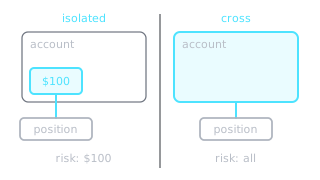
Isolated vs cross margin: how much you are really risking
In isolated mode (isolated margin) you assign a specific amount to a position. If it is liquidated, you lose only that amount. In cross mode (cross margin) your entire free futures account balance becomes the margin. The liquidation price moves further away, but if it is reached, you can lose that whole balance.
Example: 1,000 USDT in the account, and a 5,000 USDT long position is opened.
- In isolated mode, with 250 USDT of margin (20x), liquidation comes after a drop of about 5%. You lose 250 USDT and keep 750 USDT.
- In cross mode, the whole 1,000 USDT balance backs the position, so the effective leverage is 5x and liquidation comes after a drop of about 20%. But then you lose about 1,000 USDT, which is the whole account.
On May 19, 2021, both limits were hit: the price fell 5% below the daily open in the 01:00 UTC hourly candle and 20% below it in the 12:00 UTC candle. Cross mode bought about 11 more hours, but it cost the whole account. On top of that, in cross mode several positions share the same margin: a loss in one brings liquidation closer in the others.
Why beginners often lose money with leverage
Futures on crypto exchanges are not the same as CFDs (contracts for difference), but the mechanics are similar: leverage, margin and forced closing. In 2018 ESMA reported that, according to analysis by national regulators, 74-89% of retail client accounts typically lose money trading CFDs, with average losses per client ranging from 1,600 to 29,000 euros across countries. As a result, ESMA limited leverage for retail clients and capped it at 2:1 for crypto CFDs. In 2019, most national regulators in the EU adopted permanent measures that were at least as strict.
Beginner mistakes tend to look alike:
- Sizing by leverage instead of risk. 20x gets picked because “that way I will make more”, when the first thing to know is how much you can lose.
- A stop beyond liquidation, or no stop at all. Then the loss is capped by the exchange, not by a plan.
- Trying to win it back. After a loss, leverage goes up to recover the money faster. Recovery math is unforgiving: after a 50% loss you need a 100% gain to get back to where you started.
- The cost of time. Funding and trading fees eat into a position held for weeks.
The European Supervisory Authorities (EBA, EIOPA and ESMA) point out in their joint warning on crypto assets that the price of most crypto assets can rise and fall very quickly, so you can lose a large part or all of the money you invested. Leverage only increases this risk.
If you are considering leverage: what careful traders do
Careful traders start not with leverage but with the question of how much they can lose on a single trade. Example: 2,000 USDT in the account and 1% risk per trade, which is 20 USDT. The stop based on the chart is 4% below the entry. Then the position can be 500 USDT, because 4% of 500 is 20. A position like that does not need leverage. If 5x is used anyway, only 100 USDT of margin is locked, and the simplified liquidation sits about 20% below, far beyond the stop. If the stop triggers, the loss would still be 20 USDT, plus fees and slippage.
The key point: the loss on a single trade is driven first by position size and the stop. Leverage becomes dangerous when it is used to make the position bigger, or when the liquidation price ends up closer than the stop. We show how to calculate position size step by step in our article on risk management and stop loss, and support and resistance levels help you understand where to place a stop.
- Risk per trade is set before leverage is chosen. A commonly cited limit is 1-2% of the account.
- The stop is placed closer than the liquidation price, with a buffer for slippage. The liquidation price is checked in the exchange window before the position is opened.
- Isolated margin is used so that a loss on one position cannot reach the whole balance.
- If a position is held for more than a day, the funding rate is monitored.
- Leverage is not increased after a loss.
- Practice comes first, without money: decisions are made on historical charts and the results are written down.
In the Skenuok app, the AI chart scanner plan shows the entry, stop, targets and invalidation rule, and the daily market context shows the BTC funding rate and the change in open interest. You can practice without risk in the Decision modes and in the “Guess before the AI” training. These are learning tools, not instructions: you make the decisions and carry the risk yourself.
Frequently asked questions
What is leverage in trading, in simple terms?
What is futures trading and how is it different from spot?
What is liquidation and when does it happen?
Can you lose more than you put in with futures?
What leverage is suitable for a beginner?
Want to learn how to plan your stop and position size on real charts without risking money?