Funding rate
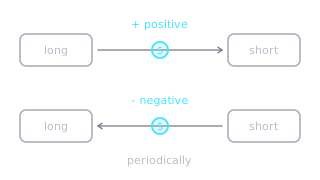
A periodic payment between longs and shorts in perpetual futures. When it is positive, longs pay shorts; when it is negative, the reverse.
Why it exists
Perpetual futures have no expiry date, so their price can drift away from the normal spot price. The funding rate pulls the two back together. When the contract trades above spot, funding is usually positive and holding a long costs more. When it trades below, funding usually turns negative and shorts pay.
How it is calculated
The payment goes straight between traders; the exchange keeps none of it. For the BTCUSDT contract, Binance settles it every 8 hours: at 00:00, 08:00 and 16:00 UTC. The base interest part is 0.01% per period, so in a calm market funding often sits at exactly 0.01% (Binance rules). The payment equals the position value multiplied by the rate.
Example: a long worth 10,000 USDT pays 1 USDT every 8 hours at a 0.01% rate. At 0.088% it pays 8.8 USDT, or about 26 USDT a day if the rate stayed the same. It is charged on the full position value, not on the margin, so with leverage the cost is much larger relative to your margin.
Real example: BTC in March 2024

On 5 March 2024 the funding rate on the Binance BTCUSDT perpetual reached 0.083% (08:00 UTC) and 0.088% (16:00 UTC), roughly 8 to 9 times the 0.01% base (Binance data). It showed a market full of leveraged longs. The same day spot price briefly dropped from 69,000 to 59,005 and closed at 63,724. High funding did not point to a date, but it did show a one-sided, crowded market. In a market like that, forced liquidations can make a sudden move bigger.
Common mistakes
- Forgetting funding when holding for days. Even a small rate paid three times a day adds up to a real cost.
- Reading high funding as a sign that price is about to fall. From late February to mid March 2024 funding was often above 0.05%, while price rose from about 57,000 to 73,000 over the same weeks.
- Confusing it with the trading fee. You pay the trading fee to the exchange for each trade, while funding goes to other traders.
How to practise
You can follow funding without opening a position: exchange pages for perpetual contracts show the rate and its history. For a few weeks, write down the BTC rate next to the price and see how it changes after sharp moves. In the Skenuok app, the daily market context shows funding changes next to other market data. Read more about leverage risk in Leverage and futures.
Frequently asked questions
Who pays the funding rate?
Does funding apply to spot trading?
What does a negative funding rate mean?
You can review and test yourself on these terms in the Skenuok app.