Take profit
A take profit is an order that closes the position automatically when price reaches your profit target. That locks in the gain even if you are not watching.
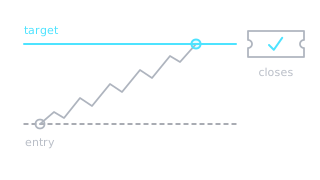
How a take profit works
A take profit can be a plain limit order at the target price or a conditional order that triggers when price reaches the target. For a long the target sits above the entry, for a short below it. When price reaches the target, the order fills, even if you are asleep. If price never gets there, the order waits until you cancel it or the position is closed some other way, for example by the stop.
The target and the stop together set the risk to reward ratio. Entry 100, stop 98, target 106: risk 2, potential gain 6, ratio 1:3.
Where to set the target
- Just before resistance: sellers often show up near a previous high. A target placed before the resistance level is more likely to be reached than one beyond it.
- In parts: part of the position closes at the first target, the rest is left for a second one. Some traders then move the stop to the entry price (break-even stop).
- From the chart, not from hope: the target must be realistic for the structure, not the number you "need".
Real example: BTC in summer 2024
In May and June 2024 BTC/USDT stalled twice near 72,000 (highs of 71,979 on 21 May and 71,997 on 7 June). On 5 July price had dropped to 53,486. Suppose a long was opened on 9 July at 58,050 with a target at 69,500, before the resistance zone. On 29 July price rose to 70,080: the target filled, while the zone itself was never reached. On 5 August the low was 49,000, below the entry, so waiting for a breakout would have turned the gain into a loss. This is hindsight: nobody knew in advance that price would turn.

Common mistakes
- Having no target and waiting for "a bit more". Unrealised profit can vanish within hours.
- Setting the target exactly on a level or round number, where price often stops just short.
- Choosing an unrealistic target just to make the ratio to the stop look good.
- Closing a winning position too early out of fear while holding a losing one out of hope.
How to practise
Take 10 historical bounces from support and mark the nearest resistance for each. Note how many times price reached a target placed before the level and how many times it stopped earlier. Mark separately the cases where price stalled just a few percent short of the level. That shows whether your targets are realistic. More on targets and stops: Risk management and stop loss.
Frequently asked questions
Do you have to use a take profit?
What is a partial take profit?
How is a take profit different from a stop loss?
You can review and test yourself on these terms in the Skenuok app.