Stop loss
A stop loss is a preset order that closes the position if price moves against you to a certain level. It caps your maximum loss on a single trade.
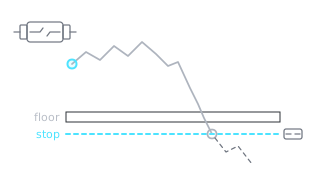
How a stop loss works
A stop is a conditional order. Until price reaches the set level it just waits. When price gets there, the order triggers and the position is closed. For a long the stop sits below the entry, for a short above it.
There are two main types. A stop-market order closes at the market price once triggered: the fill is almost certain, but the price can be worse than the level you set. A stop-limit order places a limit order: you control the price, but in a fast move it may not fill. More in stop orders and slippage.
Where to place it
The stop goes where the trade idea is no longer valid, not where the loss still "feels fine". For a long that is usually a little below the support zone, for a short a little above resistance. The distance to the stop together with the position size decides how much you lose if the stop is hit.
Real example: BTC in the 2024-2025 winter
From late November 2024 to February 2025 BTC/USDT bounced several times from a zone around 89,000-91,500. On 13 January a wick dropped to 89,257, but the day closed at 94,536. A stop just below 90,000 would have been hit even though the level held, while a stop with a buffer below the zone would not. On 25 February price closed below the zone at 88,680, and by 11 March it had fallen to 76,606. For a long, a stop under the zone would have capped the loss at a level known in advance.

Common mistakes
- Not using a stop at all, or keeping it "in your head". In a fast move it is too late to decide.
- Placing the stop exactly on a round number or level, where wicks often reach. See stop hunt.
- Moving the stop further away as price approaches it. That turns a limited loss into an open one.
- With leverage, placing the stop beyond the liquidation price. Liquidation then happens before the stop.
How to practise
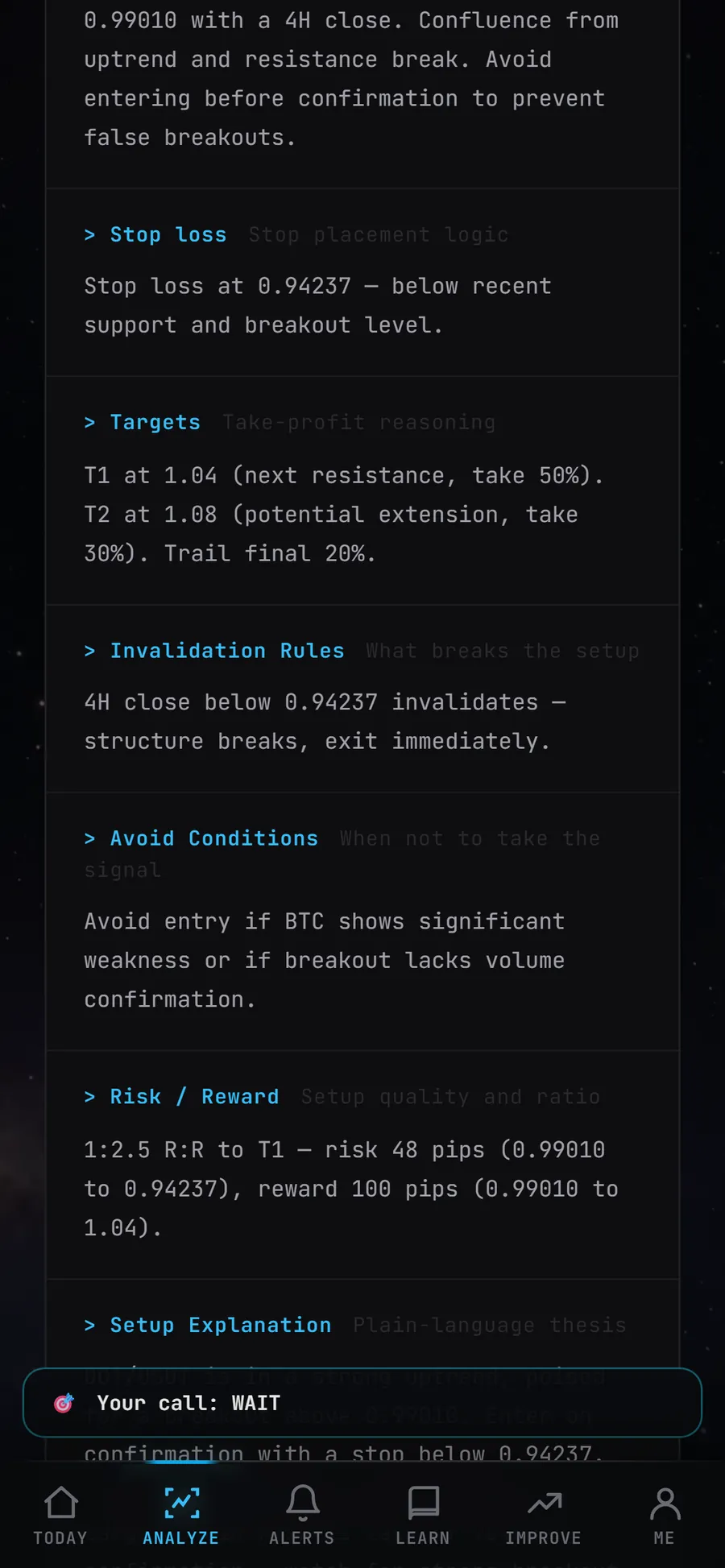
Before every practice trade, write down three numbers: the entry, the stop, and what percentage of the account you would lose if the stop were hit. Later check whether your stops sat where the idea really stopped being valid. The Skenuok app's scanner plan shows the entry, stop, targets and invalidation rule, so you can compare your choice with it. The full system: Risk management and stop loss.
Frequently asked questions
Does a stop always fill at the exact price?
What percentage should a stop be?
How is a stop loss different from a take profit?
You can review and test yourself on these terms in the Skenuok app.