Perpetual futures
A perpetual future is a futures contract with no end date, used to open longs or shorts with leverage. Its price is kept near spot by the funding fee that longs and shorts regularly pay each other.
Futures and spot
On the spot market you buy the coin itself, and it lands in your account. A futures contract is an agreement on a future price: you do not hold the coin itself, and the result depends on how the price changes. A classic futures contract has an end date, for example the end of a quarter.
A perpetual has no end date: the position can stay open for as long as the margin allows. When people in crypto say "futures", this is usually what they mean.
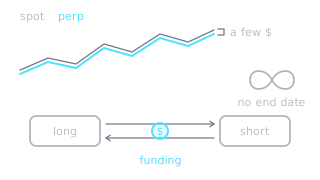
How the price stays near spot
Without an end date the contract price could drift away from spot. The funding rate prevents that. When it is positive, longs pay shorts; when negative, shorts pay longs. For example, Binance's default funding interval is 8 hours, though some contracts settle more often, and the money moves between traders, not to the exchange (Binance documentation).
What they are used for
- Shorts: you can open a short that gains when price falls.
- Leverage: the position can be several times larger than the margin.
- Hedging: if you hold coins on spot, a short can soften the impact of a price drop.
A worked example
Say you have 200 USDT of margin and open a 5x long BTC perpetual: the position is 1,000 USDT. If BTC rises 3%, the position gains 30 USDT, which is 15% of the margin. If it falls 3%, you lose 30 USDT. On top of that come the trading fee on 1,000 USDT and the funding for every period the position stays open.
EU financial supervisors warn that many crypto-assets are highly risky and speculative, and buyers can lose all the money they put in (ESMA, EBA and EIOPA, 2022-03-17). Leverage adds to that risk.
Common mistakes
- Forgetting the funding rate. A position held for a long time can pay more than expected.
- Mixing up futures and spot prices and drawing levels on the wrong chart.
- Not knowing your liquidation price and margin mode.
How to practise
On one exchange, compare the BTC/USDT spot and perpetual charts: they almost match but are not identical. Then, for a few practice scenarios, work out the position size, the liquidation price and a week of funding costs. Note what holding the position for a month would cost if the rate stayed the same. More in Leverage and futures.
Frequently asked questions
How do futures differ from spot?
Who pays the funding rate?
Can you hold a perpetual for years?
You can review and test yourself on these terms in the Skenuok app.