Leverage
Leverage is borrowed funds that let you open a bigger position than your own money allows. It magnifies profit and loss equally.
How leverage works
Leverage shows how many times larger the position is than the margin you put in. With 100 USDT of margin and 10x leverage you open a 1,000 USDT position. Profit and loss are calculated on the whole position, so a 1% price move changes the margin by 10%. If it is a long and price rises 3%, it gains 30 USDT, which is 30% of the margin. If price falls 3%, you lose 30 USDT and 70 USDT of margin is left.
On crypto exchanges leverage is mostly used with perpetual futures and margin trading.
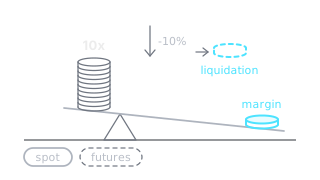
How big a move wipes out the margin
| Leverage | Move against you that wipes out the whole margin |
|---|---|
| 2x | 50% |
| 5x | 20% |
| 10x | 10% |
| 20x | 5% |
| 50x | 2% |
| 100x | 1% |
Real liquidation comes even earlier, because part of the margin must remain as maintenance margin and fees are charged. For example, on 10 October 2025 BTC/USDT fell about 11% within one hour (Binance spot data): a move like that is enough to wipe out the margin of a 10x long.
What regulators say
In 2018 the European Securities and Markets Authority (ESMA) limited leverage on crypto CFDs (contracts for difference) to 2:1 for retail clients. The same announcement cited national regulators' analyses showing that 74-89% of retail accounts typically lose money trading CFDs (ESMA, 2018-03-27).
Common mistakes
- Choosing leverage by how much you want to make rather than how much you can lose.
- Assuming a small margin means small risk. With high leverage a small margin disappears after a small move.
- Leaving a leveraged position open overnight or over the weekend without a stop.
- Ignoring fees: the trading fee is charged on the whole position, not the margin, and perpetuals add a funding rate.
- Raising leverage after a loss to win it back faster. See recovery math.
How to practise
Before using leverage with real money, work out for each practice trade the position size, the distance to the stop and the rough liquidation price. Also note what percentage of the account you would lose if the stop were hit. The stop must always be closer to the entry than liquidation. The full topic: Leverage and futures.
Frequently asked questions
Does leverage by itself increase risk?
Do you need leverage to learn trading?
What is the difference between leverage and margin?
You can review and test yourself on these terms in the Skenuok app.